Our CEO on Konnected Minds: Why trust is what holds Ghanaian businesses back
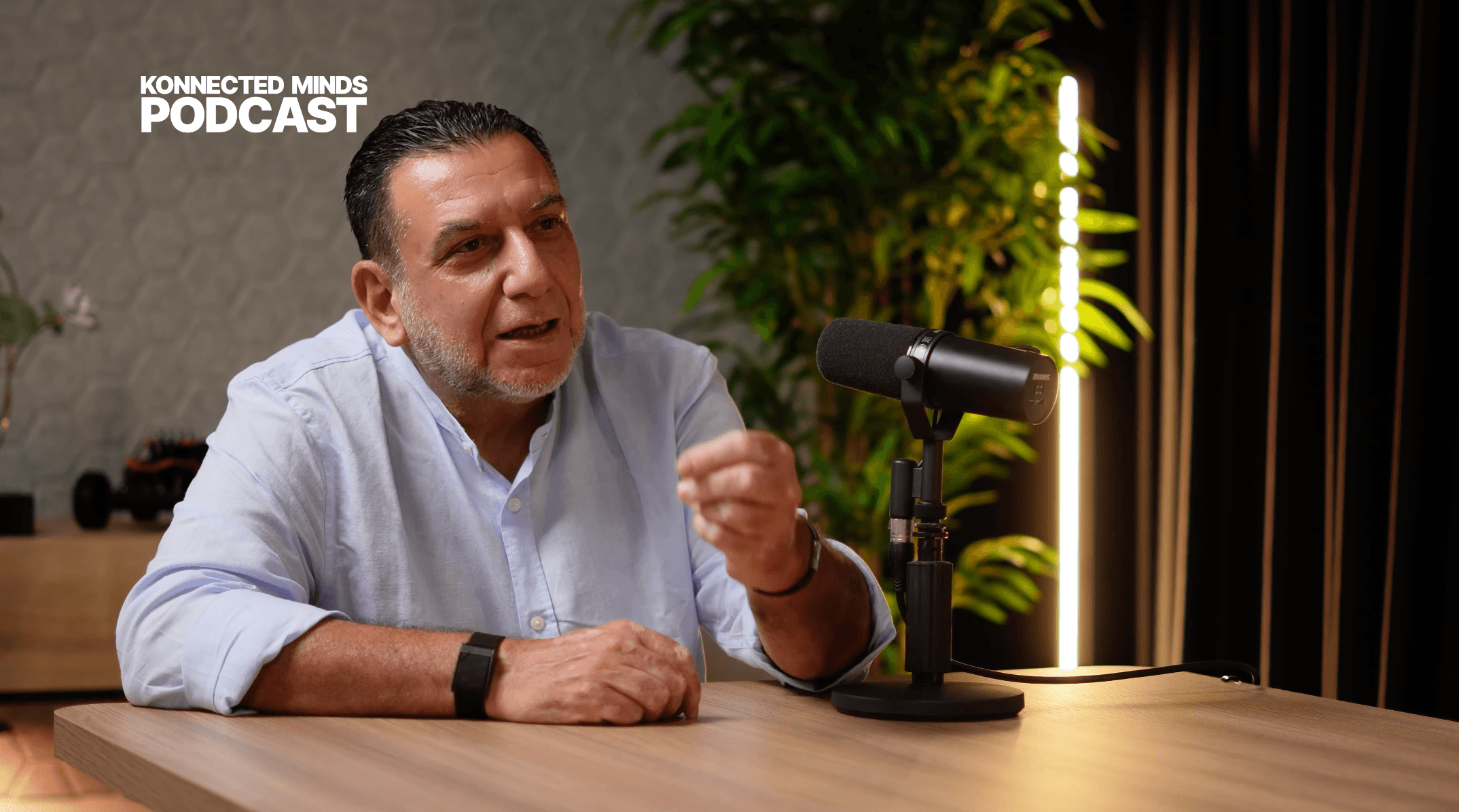
Our CEO, Fouad Chalabi, recently sat with Derrick on the Konnected Minds podcast, and four lessons from that conversation shape how we think about building here.
By Daakye Digital
Our CEO, Fouad Chalabi, recently sat with Derrick on the Konnected Minds podcast, and four lessons from that conversation shape how we think about building here.
Fouad arrived in Ghana in September 1998 on a six-month contract and never left. After seven years as a commercial director in telecoms, he quit to build his own business around a simple idea, unit transfer, which he credits with preparing people for mobile money.
1. The trust gap is real, but the cause is not what people think
The gap is above all one of trust, and withholding trust is expensive.
Derrick asked him directly: is it a case of competence or trust? Fouad's answer was "especially trust". His test is the banking sector. Which bank in Ghana runs 100% on expatriate staff? None. Business owners trust Ghanaian employees with their money every day.
"So you trust your money in a bank which is handled by Ghanaian employees, but you don't trust your own financial [director]. … You are not looking [for a Ghanaian]. And if you find [one], you are not giving him the same treatment. … So people start asking, why should I give more if I'm getting less?"
Fouad Chalabi, Konnected Minds
As Fouad sees it, the problem feeds itself. It is also expensive. A foreign finance director can be paid five or even ten times what a good Ghanaian one would earn, without knowing the local tax law. He tells his Lebanese friends that he saves more money than they do by employing good Ghanaians.
His own experience backs this up. When he started his first company, three or four Ghanaian employees chose to leave their jobs and join him, and he was the only expatriate. It was, in his words, a company that "transformed the telecom industry". One Ghanaian colleague has worked with him for almost 27 years, and Fouad says he would not be where he is without him.
2. Listen before you propose: the lemon you never asked about
Most of us propose before we listen, and we leave value on the table.
Fouad says that in a negotiation, people arrive having already decided what they want, and the whole discussion becomes an attempt to get there. Nobody asks what the other side actually needs.
His example is a lemon. Two people want to share it, and the instinct is 50/50. But ask what each needs it for, and one may want the juice and the other the zest. Both can have 100%.
"But for us, we came into a discussion, we see and we decide that, like you know, I want 50/50. … but if you move the conversation to what do you want to do, how we can work it out, it's totally different."
Fouad Chalabi, Konnected Minds
The habit reaches beyond negotiation. The people who build the best relationships, with employees, partners and customers, make others feel heard before they feel managed.
3. Distribution is the product: technology just enables it
Technology enables a product, but reach is what makes it work.
Fouad noticed that people buy everything in sachets. With limited disposable income, say GH₵10, many could not afford the cheapest GH₵7.50 voucher, but they could spare 50 pesewas for airtime. So unit transfer let people send 50 pesewas of airtime by SMS, for two days of service.
The technology was not what made it work. Distribution was. The special SIM cards that carried the airtime transfer feature were sold through Ecobank branches across the regions.
"Okay, you have the service, how do you distribute it? … I was in charge of sales and distribution, so I had a lot of knowledge about … how can I reach down to there."
Fouad Chalabi, Konnected Minds
Demand for unit transfer grew so fast that it accounted for 65% of MTN's airtime revenue as at 2008, because it answered the affordability and convenience needs of the consumer. Mobile money arrived later in a market that already understood sending value by phone, and it travelled on the same distribution network.
The business that reaches and gets people wins.
Building that network is not a support function. It is the core of the business.
4. You cannot grow what you refuse to let go of
The owner who cannot delegate becomes the ceiling of the business.
Fouad is direct about what separates family businesses that stay small from those that become institutions. Every decision routes through one person, and when that person is absent, the operation slows.
"For me, the measure of success is when you move from generation to another and the business goes beyond the person who started it. It is like moving the business from ownership to organisation to corporate."
Fouad Chalabi, Konnected Minds
The first step, he says, is to let go, by delegating. He describes a specific failure: an owner gives a manager the rules, then overrides the manager whenever a customer escalates. The message to the team is that their authority means nothing, so they stop using it and every decision comes back to the top.
Managing by fear has the same limit: it depends on the owner being present. A good leader, Fouad says, does not have to be there all the time.
There is a lot more in the conversation than we could fit here, from his early days in Ghana to the story behind unit transfer.
This is the first in a four-part series on trust for Daakye Insights. We will release three more articles that break down the full episode.
Fouad Chalabi is the Co-founder & CEO of Daakye Digital. This piece draws from his appearance on the Konnected Minds podcast, published on 5 October 2026.