
What 27 years in Ghana taught our CEO about building businesses that last, one rule: understand people first
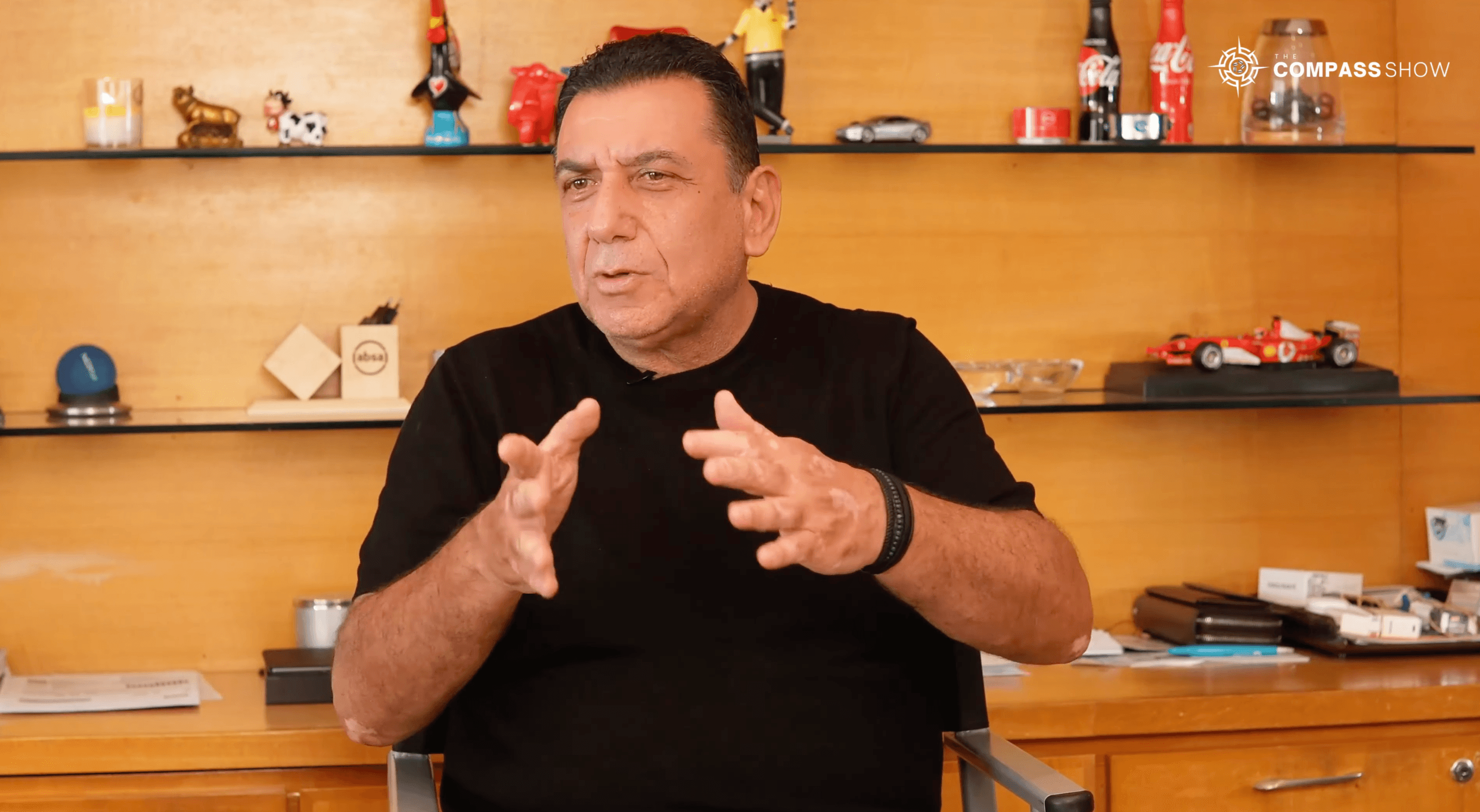
Fouad Chalabi came to Accra in 1998 for a six-month posting. He never left. In a recent episode of The Compass Show, he shared the principles behind nearly three decades of building businesses in Ghana. Here are five that stayed with us.
By Daakye Digital
Fouad Chalabi is Lebanese by origin, Ghanaian by naturalisation, and an entrepreneur by accident. He grew up during Lebanon's civil war, served with the International Red Cross through Rwanda's genocide, and landed in Ghana to work in mobile telecoms — first at Spacefon, then Areeba — before leaving corporate life to build on his own. His advantage was never money or connections. It was curiosity.
These are five lessons from his interview that we believe every founder building in Ghana should carry.
1. The most expensive management mistake is skipping curiosity
When Fouad joined Spacefon's sales team, he noticed something his Lebanese colleagues — who had been in Ghana far longer — had missed entirely. Staff were arriving at the office by 6 AM, two hours before their shift. By 3 PM, some were visibly exhausted. Management saw a performance problem. Fouad asked a question: why are you arriving so early?
The answer was simply commuting. Employees from places like Kasoa had to leave home before 4 AM to make an 8 AM start. By late afternoon, they had been awake for over twelve hours. There was no laziness — there was a commute that the management structure had never accounted for.
"Understanding the behaviour, the culture — that gives you a lot of insight about how to deal with people. And then your team is ready to work, instead of looking at you like you're just giving orders." — Fouad Chalabi, The Compass Show
His response wasn't a policy — it was empathy. He stopped judging, started accommodating, and built a team that trusted him. He later ran a company of 140–150 Ghanaian employees with zero expatriate staff. His formula: pay people well, build good systems, invest in technology.
The lesson isn't about commutes. It's about what happens when you replace assumption with a question. Curiosity is a management tool that costs nothing and changes everything.
2. The sachet economy is a demand signal, not a poverty signal
One of Fouad's most important business observations happened not in a boardroom but walking through Accra's streets. Everything was sold in small, single-use sachets — water, Milo, cooking oil, washing powder. Coming from Lebanon, where large-format supermarket shopping was the norm, it struck him as unusual. Most of his peers ignored it. He dug deeper.
What he found was a simple economic truth: most Ghanaians manage money day by day. A taxi driver earning for the day can't buy a month of groceries. He buys for the day, in the quantities he can afford today. No fridge, sometimes no electricity, no excess cash to float a larger purchase.
"Majority of Ghanaians live for the day and have money for the day. If I'm a taxi driver and I have 50 cedis, what I'm shopping for is for the day." — Fouad Chalabi, The Compass Show
The sachet wasn't a constraint to design around. It was a demand signal to design toward. The business that understood this first won the market before anyone else knew there was a market to win.
3. If the last person in the chain earns, you do not need to advertise
Before launching the unit credit transfer, Fouad faced one central objection: do you really think people will stand on a street corner, collect money from strangers, and wait for an SMS to confirm the transfer? His answer was yes — because the agent would earn.
He designed the 50-pesewa unit so the street agent could sell it at 60–75 pesewas. The margin was small, but the volume was enormous — and the agent became the marketing channel without any spend from Fouad's side.
"Without advertising, the guy on the street will advertise — if the person at the end of the chain is making money." — Fouad Chalabi, The Compass Show
Demand became so strong that a black market emerged: people who held the special SIM cards required to perform transfers were reselling them at multiples of face value. The product distributed itself. Design for the bottom of the chain first. The top takes care of itself.
4. Success has three inputs — most people only manage one
When asked what separates those who succeed from those who don't, Fouad offered a framework he called "the formula." Hard work alone is not enough — he has seen people work hard their whole lives and achieve little. Talented people go nowhere because they don't work the talent. And people handed perfect opportunities still walk away empty-handed.
"I want to work with people who are hungry — not for food, but for achievement. I want to achieve. I want to do. That is the feeling that makes things happen." — Fouad Chalabi, The Compass Show
The variable Fouad emphasises most is urgency. His observation: many people are content — and he doesn't say this critically, but as a pattern that affects how opportunities are taken. When hard work and talent are present but urgency is absent, chance passes. The door will open. The question is whether you feel the urgency to walk through it.
5. Protect the idea. Build the system. Never make yourself the only exit.
Fouad's biggest professional regret is not patenting the unit credit transfer product. He built everything internally, kept it inside the company structure, and when Areeba was sold to new owners, what he had created was transferred with the business. He lost something he had invented.
The second lesson came later, running restaurants and other businesses. Most founders — in Ghana and everywhere — build companies that only function when they are present. Every cheque needs their signature. Every decision waits for their call. That is not a company; it is the founder with staff around them.
"If you build an organisation, it should work with or without you. People here build things around themselves — if I am not in the office, nothing will work. That is not a business. That is a job with extra steps." — Fouad Chalabi, The Compass Show
| Principle | What it means in practice | What happens without it |
|---|---|---|
| Protect the idea | Patent, register, document before sharing or building inside a company you don't fully own | You can lose what you built when ownership changes hands |
| Build the system | Processes, controls, and technology that keep the business running without you in the room | The business stops when you stop — scaling becomes impossible |
| Invest in technology | Technology is the control layer — not a luxury add-on for when the business is bigger | Manual processes create the ceiling that prevents growth |
On succession, his advice was direct: don't bring your child into the business straight from education. Send them somewhere hard, somewhere they are not the boss's son, somewhere they will earn discipline they didn't choose.
Discipline, he says, is the single biggest ingredient in any life — more than talent, more than opportunity. It is what holds everything else together when chance finally arrives.
What This Means for Builders Today
The businesses that last are rarely built on assumptions. They are built on curiosity, observation, and a deep understanding of how people actually live and behave.
The lessons from Fouad’s journey reinforce a simple principle: understand people first, build around real needs, and create systems that can scale beyond the founder.
At Daakye Digital, these principles continue to shape how we approach product development, market entry, and growth across the businesses and solutions we help build.
Watch the full interview on The Compass Show below